Doctors in a foreign land

     As Antoinette and I continue to work hard, I just wanted to reflect on our time here. I sit to write and plan on just letting whatever comes to my head out on paper. We are leaving here on Friday morning for our firstvisit back home to Chicago, we will take the boat to Iquitos where we may have a minute to breath, but probably not too much rest because we will have to transport a patient and make sure they get care in the hospital and also need to look into things like lab machines that may help improve our patient care up on the river. We then fly to Lima on Sunday and have a red eye flight on Monday night arriving in Newark early Tues morning before arriving back to Chicago for the month.
     In our time here we have begun to establish some relationships with our co-workers and others in the community. We have been comfortable treating diseases that were very unfamiliar and anxiety provoking our first few weeks here such as snake bites, dengue fever and malaria. We also are more comfortable managing illnesses without the elegant exams and tests we were very accustomed to back home. We have become frustrated with the red tape and paperwork required here in Peru such as the insurance forms and all the documentation that the government requires. Padre Jack refers to it as "their insatiable hunger for numbers" which in the end get filed somewhere in Lima and serve no purpose because nobody does the epidemiology or usues the numbers for a good use. They are an necesary evil because we need to get as much from the national insurance company for what we do; as many patients cannot pay much more than the fee to have a consult, our clinic needs all h income we can generate. The difference our budget from income to debt is made up by the donations mainly from the Canadian Oblates and US Norbertine abbey in Wisconsin. Thus, Pango (a civil association) was formed to keep funding, projects and healthcare going on the river as inevitably Padres (Jack and Moe) will at some point depart for home and hopefully have nice relaxing time after their service for some many years here in Peru.
     We have done some interesting things as I look back it is pretty amazing to accomplish/perform this high quality medical care in the jungle and it can all be attributed to the drive, ingenuity and passion that Padre Jack and Moe have had over the last 25+ years. One example is c-sections, i even assisted Antoinette on one a few weeks ago. Can you imaging operating with your spouse??? It went very well. We have done spinal anaesthesia, spinal taps, incision and drainage of abscesses, intubations, given supplemental oxygen for pneumonias, IV antibiotics, sutures of big wounds, pre-natal ultrasounds, liver/gall bladder ultrasounds, dilation and curretage after incomplete spontaneous abortions, emergency transports to Iquitos. We even attempted peritoneal dilaysis in the last moments of one patient's life as a last effort to save her. There is more to do and more we can help with, and we are inspired everyday by Padre Jack, Dr. Juan Jon, the staff and all the students and volunteers that come through and ask us the challenging questions that help us all learn together.
    Our one patient Hucielita who was an 11yo girl with renal failure will forever stick in my memory. She came to clinic shortly after we arrived as a 10yo girl. Her mother told me "her face has been swollen for the past 2 weeks" which is a textbook presentation for a renal problem. So i checked her urine and labs to confirm glomerulonephritis. In the hosptial she celebrated her 11th b-day, we sang to her and Ant and I gave her a sucker and a beanie baby as a present. She improved with IV medications and blood pressure medications and we sent here home with the thought that if she does not improve in 1-2 months with her blood pressure or protein in her urine she will go to Lima for a renal biopsy. She came back for an outpatient follow up with improved blood pressure and less protein in her urine. Her chronic anemia made us think maybe chronic renal disease, but still no signs of alarm. She came back once more again improving, but we started to discuss a transfer if the next visit she did not resolve all of her symptoms. Her transfer is not an easy thing, we have to fill out papaerwork, find money for the trip for her and a parent, have the hospital in Lima accept the patient and then convince patients to travel. Often the patients have never left the 5-6 hour radius of their home town, seen the city, let alone flown in a plane. They all worry about not being able to pay, which is legitimate because not one person on the river has enough money to get to Lima on their own. When she came back 5 weeks later it was 3am and Padre Jack was on call and woke me up for a consult. She was grossly fluid overloaded and in respiratory distress. She was having acute renal failure likely in the setting of already damaged kidneys. She was not stable enough to transfer by boat to Iquitos. We did our best here, but her kidneys shut down in front of our eyes. We even arranged for an rare airlift to Iquitos, but 2 days of rain cancelled the flig each day as it was too dangerous to fly and land on the river in the weather conditions. We had her on diuretics, dopamine, oxygen and even tried dialysis. Shortly after midnight she coded and died. It hurt, very sad case. This was a very happy smiling girl who lives in poverty with loving parents and a chronic disease. She succumbed to her disease despite our efforts, a disease that would likely not have killed her in a developed country. Her father was very appreciative and thankful for our efforts, he took her home that night to bury her. Mom was understandably upset and angry that she lost her daughter. It was a sad day for all of us.
    The diseases here interesting to say the least. I will list what we have seen, and for those not in medicine you might be bored or cannot pronounce half the diseases but here it goes: malaria vivax and falciparum, dengue fever, meningits with brain abscess (confirmed on CT in Iquitos), premature babies, pneumonia, asthma, pyelonephritis, snake bites, cerebral malaria, glomerulonephritis, BPH, vulvar cancer, chronic pressure ulcers, pterygium, acute coronary syndrome, diabetes, congestive heart failure, persistent ductus arteriosis, hydrocephaly, metastatic cervical cancer, tuberculsosis pulm and in the GU tract, lymphadenitis, Hodgkins lymphoma (diagnosed on our LN biopsy and transferred to Lima for treatment), HIV, toxoplasmosis, necator americanus, ascariasis, trichuriasis, Hymenolepsis nana, Strongyloides, Leischmaniasis, hepatis B, cirrhosis, bleeding esophageal varices, congenital fibrotic bands causing bowel obstruction, cleft lip/palate, failure to thrive, supracondylar fracture, fractured mandible, mastoiditis, LGV from chlamydia, rheumatoid arthiritis and last but not least Antoinette just called me for a consult on a 10yo boy that fell and now has a scrotal hematoma...ouch. Well off to read more on the management of scrotal hematoma. Life is never dull here in the jungle, happy to be doing what we are doing and learning so much. Also glad to be coming home for a bit, for a break and see friends and family. The batteries need a little re-charging. See you soon.


Crash

Inez arrived at 9pm with labor pains. She had no prenatal care and didn't know how far along her pregnancy was. By ultrasound, she measured 30 weeks which is one and half months PREMATURE. Her cervix was not opening, but we gave her some IV fluids and steroids to mature the baby's lungs. We don't have surfactant here (helps premie babies breath) and we wanted to give the baby as much time as possible inside mom. The next morning, she started having strong labor pains. Within 30 minutes she was fully dilated, which isn't surprising being that this was her 8th pregnancy. Dr. Juan did an exam to check for dilation and realized that she had a CORD PROLAPSE... the cord came out and the baby's head was compressing it against the pubic bone. "There is a pulse" he said. Seconds later as we prepped the OR, "there is no pulse." We delivered a live baby under LOCAL ANESTHESIA, but the baby was very preterm. I put lidocaine in the skin, and when there was a delay in obtaining more lidocaine, I just made two cuts and pulled the baby out. Mom was given Ketamine immediately and thankfully doesn't remember being opened without much anesthesia. Dr. Juan was scrubbed with me and multiple times he reminded me to breath. Brian and Jason Howell worked on the baby. She was having trouble breathing so Brian intubated him. Lili the nurse started a peripheral IV and the baby got a bolus and then dextrose and antibiotics. For two hours we helped the baby breath with an ambu and a little bit of oxygen. Meanwhile, we were trying to coordinate getting him to Iquitos where they have surfactant and a ventilator. The 5 hour boat ride + 10 min mototaxi + 1 hour boat ride + 15 minute mototaxi (normal mode of transportation) was out of the question, so we called the military to ask them to transport the baby by helicopter, which would take only 2.5 hours. After over two hours, the baby decompensated, the heart rate and oxygen level dropped, and the decision was made to remove the tube and bring her to mom. We don't know why...maybe pneumothorax? It was a sad day. Mom is doing well. She went home today (across the river) and will be back in a few days to remove her staples. Pray for Inez and her family and baby Julia.
Toni
27 March 2012

Our new puppy


As most of you know Antoinette never wanted to get a dog or any animal for that matter. However, since being in Peru she has grown accustomed to all the animals around, namely the pregnant cat Sabrina, several dogs and roosters. It was even at the point where she made a small little area for the cat to sleep on and left out a bowl of milk for her at night. Antoinette even thought about raising one of the kittens. Sabrina delivered over a week ago but we have not seen a trace of any of the kittens. Our friend Victor Hugo had a litter of 10 puppies from his dog China a mix between a pit bull and german shepard. When I asked if we could have one he said sure, even though he thought about keeping a male dog that could go hunting with him, he was happy to give us one of the puppies. When Antoinette went up river this month for 10 days (Victor went as well) I thought it was a good time to retrieve our puppy. He was about 6 weeks at the time, which is usually a little early to take away from mom, but his mom still wandered around at night and he would latch on 2-3 times a day to feed from her. He whined at night and liked to poop on the floors, but if I let him out enough he did not have any issues. He sleeps on our patio now and is growing well. I de-wormed him once with the pills hidden in a piece of hot dog. When Antoinette arrived she was happy to play with our cute happy little puppy, however I am still relegated to doggy dookie duty.
We named him Wookie (still not sure about the spelling), which is a word in the local Kichwa language that means brother or friend. When I asked my nephews Caden and Henry via skype what should we name hime, they came up with River Monkey, so that is what he is referred to back home. All the locals seem to think Wookie is a great name, and he will wander around the hospital and clinic when we are done seeing patients in the afternoon. The staff and patients are getting to know him and the kids love playing with him.


Dia 2- Rumi Tuni

April 1, 2012

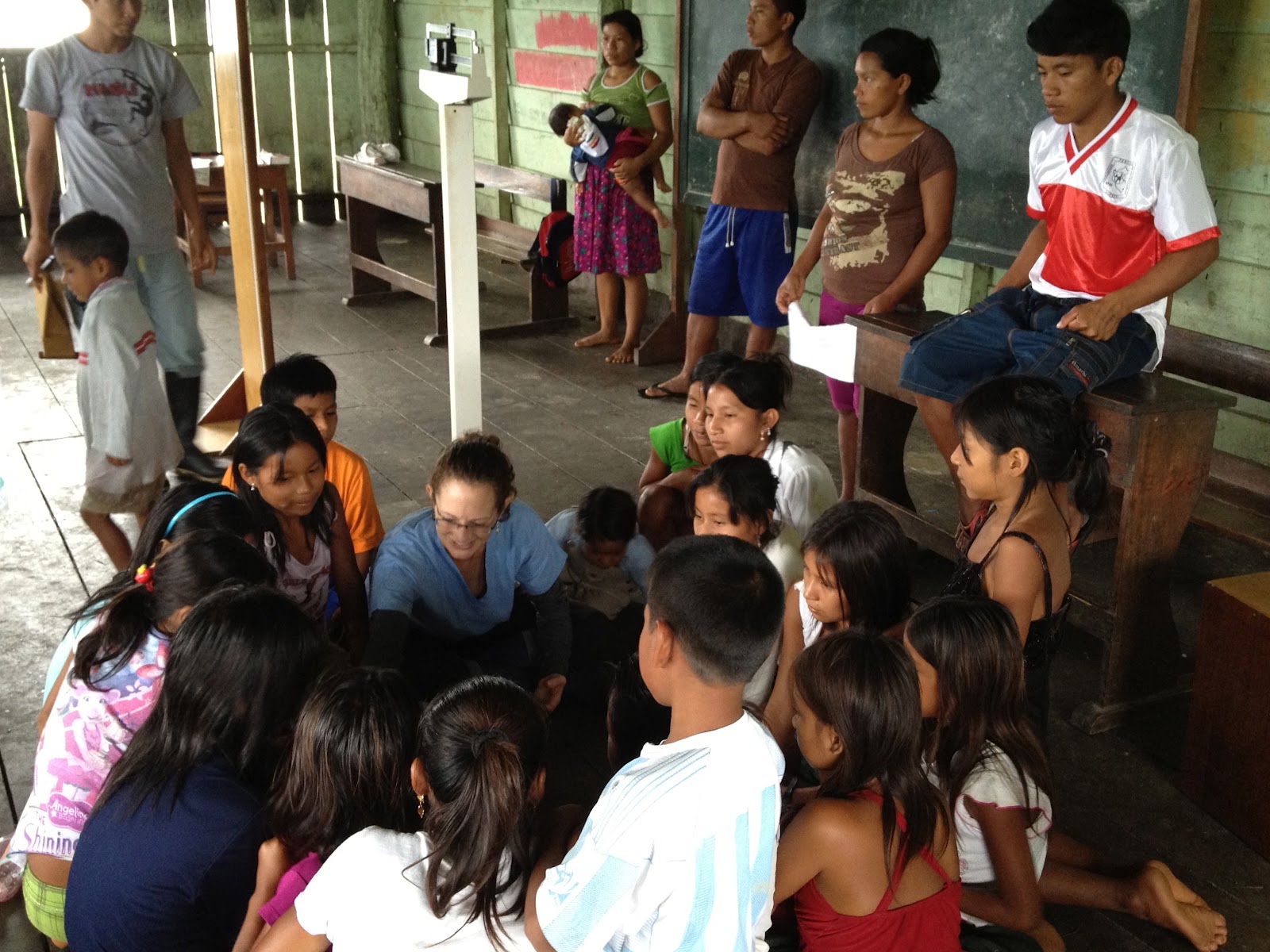
I am tired. We worked in Rumi Tuni today, one of the bigger towns we’ll vaccinate. The clinic structure is beautiful, but inside is sparse. We didn’t even have chairs for the patients to sit on today. From 8am-5pm, I saw over 30 patients. Seeing Mari was a highlight today. She is 3 years old and had a congenital bowel obstruction and 8cm of small intestine removed. After her incision stopped draining stool, she was transferred to Santa Clotilde where we watched her gain weight for a week before we sent her home. Today, she came in with a fever and cough. Her complicated surgical history and skinny little body worry me a bit. She may have nothing more than a cold, but she got ibuprofen and erythromycin and I’ll see her in three days when we travel to her town. I also saw Valentin and his wife, who brought me two eggs. He was hospitalized in Santa Clotilde for severe hypertension and possible stroke, and sent home with a diagnosis of hypertension, Parkinson’s, and bells palsy (that he’s had for decades). His dizziness limits his functioning and that is his main concern. The hypertension and tremor don’t matter much to him. Again, I saw a handful of prego’s who deliver at home with their mother in law. It would be great to have group prenatal classes here, where the woman brings the person who will attend the birth, and teach them to recognize signs of alarm.With the scarcity of furniture and millions of mosquitoes, I wouldn’t think to ask them to deliver at the health post until/unless some big changes are made. By the end of the day, I just wanted to speak in English and not have to think too much. Luckily there is a phone here, so I did call Brian twice today. People here have asked, “tiene pena?” aka “are you sad” being away from Brian. While absence makes the heart grow fonder, 10 days will be a challenge.

For lunch (at 5pm) Rober Figueroa made a delicious big fish grilled in a banana leaf with some spicy cocona salsa, plantains, and rice on the side. It was dusk and within 10 minutes, the room filled with mosquitoes and you could literally hear the humm of mosquitoes coming out to graze.

I’m back on the boat, which has no mosquitos. The generator is running to power the three high-efficiency light bulbs along the ceiling. I am tucked away in my bunk surrounded by our green mosquito net (generously gifted by Dea and Jim for Christmas). My eyes are getting heavy. We will pull out of RumiTumi tomorrow morning and be awoke by the sound of the motorist starting the engine and water rushing along the sides of the boat, all while tucked away neatly away from the mosquitoes with my eyes closed.


Toni

The Journey of a Cedar tree

It came as a surprise to me how much deforestation and illegal lumbering that occurs here on the Napo River. This is something I never thought about prior to my arrival here in Peru. One often hears about how the rain forest is being wiped out, well let me tell you a little more. Precious wood such as cedar and mahogany grow here in the rain forest. Obviously people pay top dollar all over the world especially the US to have a nice wooden table or cabinets.

The story begins, as has occurred over hundreds of years, with the poor being exploited without their knowledge. The local people know where the trees are and a “padron” will come speak to a small group in the communities or have someone gather up a crew and offer them a set amount for their work over a few months. There is no contract, only an informal agreement. Some of these workers come up river from Iquitos to work as well, not just locals. The lumber men then come up the river after it is gathered and take the wood, often telling the workers they will pay them after they sell the wood in Iquitos. As you can imagine they often never come back to pay the workers and walk away with hundreds to thousands of board-feet of wood. In the US, one board-foot of cedar costs about $15.00 for you or I to purchase. The workers have no rights and they cannot complain to anyone because there was no formal contract. They also have no idea how much the wood is worth. The workers if they do get paid get 1 sole per board foot or $0.38. The wood/logs gathered are pushed down the river by a boat. They have to pass a police checkpoint and right next to the port in Iquitos is the Naval base. None of the people have permits to lumbar in the region, but a small bribe and nobody sees anything. The wood is then cut in Iquitos and the lumbar sold to dealers. There is never a new tree planted and no re-forestation projects to prevent the loss of the rain forest.

Furthermore lumbering is very dangerous!!!!!!! We see accidents almost weekly and last week 2 men died, one whose brother Victor we know very well. Victor works here for the clinic has been working with Toni on the vaccine trip. It was a very sad day as the entire vaccine group went to the small town for the funeral so Victor could attend and see his brother one last time before the burial. 3 weeks ago a purchaser from Iquitos brought his adolescent son along to help out. As their boat was pushing the wood down river, there was a log-jam and their boat hit the logs and flew on top of the wood and flipped over. His son’s head went right into one log and he had a deep massive laceration on his scalp that took me an hour to sew back up. If he had lost consciousness when the boat flipped he would have drown in the river. The dad also has no formal contract and the lumbar companies do not pay for health care if there are any accidents. There is no training for the workers, no hard hats, nothing. There are probably 1-2 deaths a month from trees falling on people. I thought; how can you get hit by a tree? After helping carry the cross made out of 2 logs for one station on Good Friday this week I can now see how heavy a large tree would be, if you take into account the size of the tree, the fact that there are several surrounding trees and large branches that never get cut off first the risk is tremendous.

I am not saying to not buy lumbar, but make sure when you do ask if it is certified lumbar. Certified lumbar should have a stamp on it indicating its source or where it came from. Certified lumbar means that the companies have a legal right to cut the lumbar, their workers are trained and have contracts and they re-forest the areas that they take the lumbar from. More information can be found at illegal-logging.info.


Brian

12 APRIL 2012

Vaccine Campaign Day 1

29 March 2012

It’s Friday and I’m sitting in my bunk, in our wooden boat. We took off from Polako’s balsa at 6 am today. Brian, Padre, Laura, Bill and I were waiting for the boat to arrive. We saw a woodenboat with a straw roof float by, as it was passing us, it made a U-turn and started approach. “Could all 9 of us be traveling in that?” I wondered. I had seen this boat before and wondered how people could possibly travel in it. It seemed very narrow, maybe 4 feet wide, and I imagined a board along the length of each wall that might fit 8 people it they sat squished together in the dark damp vessel. I was shocked when I boarded. It was enormous inside. The boat is about 8 feet in width and dividing the front and back it small kitchen, complete with propane stove and shelves stocked with food. In front, there are three foot wide benches on both sides with two big coolers full of vaccines and another full of medicine. A pink pasley hammock hangs in front of the door, which remains open for our entire journey. Behind the kitchen, there are bunks with rolled mattresses on both sides, where 8 can sleep very comfortable. Further back are another set of doors, and hidden from sight behind two barrels of gas is the motor. I quickly get used to the hum of the motor and water splashing on either side of the boat. All the water I drank was catching up to me. I ventured to the bathroom, beyond the motor in the back of the boat. There are two narrow boards on either side of the motor the shimmy back on. The motor with its loud hum churns the orange glowing water below. One wrong step and the motor eats you. I safely make it to the bathroom, and I find a toilet seat on a bucket that falls right into the river. The driver takes note that I’m back there and slows the engine to relax the river water under the toilet, which keeps my bum dry. Walking back to the front of the boat, I notice the intricate handmade roof of oja jirapay- palm leaves twisted around a stick. This roof will keep us dry and cool for our 10 days up river.


The sights are beautiful. The dark water is rich in nutrients (and mercury and lead) and the green walls of jungle flora on either side house thousands on animals and insects, many have yet to be discovered. One of those animals is the “motelo” and happens to be our dinner tonight. This large turtle was sold to us by a family in Sumallspa. As we head up river, we stop in each community we plan to vaccinate. In Bandeja Isla we ran in to a large extended family with at least 10 kids running around. They we walked into their chakra (field) where we saw a sajino named pancho, a pichiquo (tiny monkey), a turkey, dogs playing among the yucca, peppers, and peanuts.

Our first destination was Caja Marca where everyone got situated. We set up a table for Victor Hugo the renaissance man who played dentist today. Limber and Jisseli were in charge “programas” which vaccinates kids and pregnant women and follows childhood growth and development. Bill had his computer to see if patients were registered with SIS, a local public aid, and if not, he instructed them how to do so to get discounted meds and care. Manolo had his solar powered microscope and was able to do Malaria smears, stool studies, and testing sputum for tuberculosis. Almost everyone has ascaris and trichuris (worms) and we only had one patient with giardia. No one had malaria. Neo helped fill out SIS forms and was the pharmacist for the day. I set up shop in a classroom where I diagnosed lots of parasites, headaches, low back pain, common colds, and two sisters with what looked like cerebral palsey- walked on their toes, developmentally delayed, spastic… but to have CP in both sisters with an uneventful birth history is maybe less common than a hereditary muscular disease. There is no physical, speech, or occupational therapy here so the diagnosis is unlikely to lead to clinical improvement. I saw a handful of pregnant women. One has 10 kids at home and is on #11. Another is pregnant with her second child but has a transverse lie at 28 weeks… hopefully the head moves down or she may need to travel to Santa Clotilde for a Cesearian Section. Another had 10 but 4 drowned in the river. She looked sad, and her story explained why.

We continued boarded the boat and headed back downriver to Sunullacta… and yes, one of God’s creatures was served up for lunch. The motelo turned into soup. It really was delicious! For some reason, a turtle is much more appealing to me than cute fuzzy animals and monkeys. We stopped at the first sight of an orange tree to buy oranges, and picked up some puhuayu and passion fruit while we were there, and the family bought some rice from us. The barter system is commonplace and very convenient.

We had discussions on what we might do differently next trip and how we could streamline data entry- instead of using a paper book, we could use an Excel spreadsheet that would allow us to filter and pool data for quality assurance. We have a couple options for systems, but we’ll have to discuss with someone who has more experience than Bill and I.

Sunallacta has a similar feel to Caja Marca. I learned that neither of these towns have active health promoters. One moved and the other wasn’t empowered because they lacked continued trainings. I also confirmed what I learned in Santa Clotilde, that 90% of babies are delivered at home by a family member with NO formal training in labor. I would love to identify experienced members of each community and provide basic trainings on how to recognize signs of alarm and how to deal with emergencies. The multigravid patient I spoke to said that there had been no bad outcomes in Sunallacta, although there was a women in Caja Marca last month who went into labor with a transverse lie and the arm came out, and the baby died by the time they arrived in Santa Clotilde. It takes two days to get to Santa Clotilde on pecke pecke, the local mode of transportation. A trained person may have been able to save the babies life.


Sunallacta we headed to Rumi Tuni, where I am sitting now in the health post. After spending and hour filling our paperwork for insurance, I decided to type while I charge my computer and camera. There is otherwise really no electricity, although we could light the boat with the motor if we decide to do so. I walked into the sparsely furnished clinic to find swarms of mosquitos, and on a happy note an actual shower! I’m fresh and clean and covered from head to toe I clothes. I learned on my last three day trip up the Tambor River to bring “mangas largas”- long sleeves. The heat is tolerable, but the biting flies and mosquitoes are not. I’m in my cozy black pants and green t-shirt with Brian’s long socks and long sleeve white pullover, and my flip flops. While style is never really my main goal, it’s nice that here I have nothing to be embarrassed of since the main objective is just to cover your body.

I have yet to do laundry. We wash in the dark brown river water, which I’ll have to do tomorrow… or maybe pay Julia our cook to wash while we’re working? What a great idea!

Toni

The answer is.....Leishmaniasis

We posted a picture a while back showing a leg with several ulcers on it and asked for the diagnosis. Alex Rankin aswered correctly. The genus Leishmania is a parasitic disease transimitted by the bite of a sand fly. There are several species of leishmaniasis that casue cutaneous, mucocutaneous or visceral disease. Thankfully we do not have the visceral type in Peru. Treatment is a dose of IV medication daily for 3 weeks

Look for more quizes later when we have more interesting pictures

Brian
07 Abr 2012

The best part of waking up……


Thanks to Dan and Katherine we now have excellent coffee. They were reading our blog and saw I was surviving on instant coffee and they came bearing gifts: a French press, coffee grinder and 3 bags of coffee!!! So who are Dan and Katherine anyways? Well it is quite a nice story, and you can read Fr. Mauricio’s version on the PANGO website (www.pango.pe). In short, their son Nathan was a tourist coming down the Napo river several years ago from Ecuador and no one told him wearing contacts several days in tropical weather was a bad idea and he developed a corneal ulcer. The boat he was traveling on stopped to make sure he received treatment here in Santa Clotilde, and Fr. Jack took care of him, called his mother and he was flown home and followed up with Dr. Rebecca Bartow an ophthalmologist. Dr. Katherine Kaplan was moved and grateful for Fr. Jack’s care that she offered her expertise to Santa Clotilde and she has been trying to make the trip annually since.

In March she, her husband Dr. Dan, her son Nathan (medical school ), her colleague in OB/GYN Dr Joe Welton, Dr. Rebecca Bartow (ophthalmologist) and her husband Dr. Tom Bartow(rheumatology) all came to work for a week. I unfortunately was working up in Angoteros at the time, but it was a success. Several patients were able to have hysterectomies, tubal ligation, joints injections, and pteyrgium operations during their week here. The team put in a lot of effort and even broke in the new operating room and delivery room.


Charlas!


Out in the communities, we have a group discussion/lecture/learning didactic (charla) in each village we go to. On my first venture up the Tambor River, Lucio gave talks on Dengue Fever, diarrhea, and Respiratory Infections. He is such an amazing teacher! He is very organized and discusses clinically relevant points that parents, families, and health promoters can use to care for each other. We will discuss Malaria (which is on the rise), burns, first aid, hygiene, and a few other topics when we leave on our next vaccine campaign- in three days. Tomorrow's departure was postponed.

Dirty Water

We discovered that all the water here in Santa Clotilde is contaminated with bacteria/parasites that are resistant to boiling. All our patients and staff have been drinking this contaminated water. We are hoping to get a water purification system to keep the town healthy. In the meantime, we'll take our anti parasitic pills and hope that the heavy metal levels in hair/fish/water are shared with us once they are processed.
1. Bacteria- Who's been pooping in the water?
2. Parasites- roundworm ascaris, hookworm necator, whipworm trichuris, threadworm strongyloides, tapeworm hymenoleptis
3. Protozoa- giardia, entamoeba
4. Mercury- due to gold mining upriver, contaminating and harming our kids... think twice before you ask for gold for christmas, because looking pretty may not be worth the devastating environmental impact here. The difficulty is that mining brings a lot of business and jobs to our communities, and with out many would go out of business.
5. Lead- also affected by gold mining... is this why are kids have belly aches, anemia, and are not growing? or is it the parasites and malnutrition?


Headed to Alto Napo

Where the streets have no name... actually, where the towns have no streets. I'll be leaving on a vaccine campaign on Wednesday for 10 days. Eight of us will live out of a boat, bathe with river water on the boat (in a little bathroom?), eat jungle animals (although I refuse to eat monkey), wear long sleeves and pants in 80 degree weather to avoid getting eaten alive by mosquitos, and prevent hundreds of kids from getting vaccine preventible diseases. The midwife loaned me her boots to keep my feet dry and I'm heading out to town to look for a light long sleeve shirt. Most everyone upriver speaks Kichwa, an indigenous Ecuadoran language, so I'll be trying to learn a bit of that as we go. We will be passing out anti-parasite meds to everyone, since EVERYONE here has parasites. I'll also be meeting with the apo (chief) of each village we go to in order to set the groundwork for an integral community assessment project that will help us understand how to improve the health and lives of those who live in the communities we serve. I will also discuss the details of International Medical Relief's medical mission trip in July. We have a great group, and I'm excited to learn first hand how people live out in the villages.
Toni


Busy day!

The morning was moving along smoothly yesterday, when I was called from lunch to see a man with a snake bite on his hand that happened while he was cultivating his yuca. Josue the nurse technician was already starting an IV to give him antivenum. Amist evaluating him, another man walked in who accidentally cut his forearm with a machete. He has a bloody towel wrapped around it. Inside, we found the laceration to be covered with a cut chunk of human hair. This is a common home remedy here to stop bleeding until medical care is sought. As I finished sewing his arm up, a lady was brought in on a stretcher with severe headaches, fever, and weakness for 10 days. I had just enough time to get her history before I was called in for in impending delivery. When I arrived, Lucilida had been pushing for over an hour and the head was not descending, and the heart tones were dropping. After a failed vacuum attempt, we decided to do a cesarian section. Mom and baby are doing well! The man with the snake bite doesn't have too much swelling and although his bleeding and coagulation time are very prolonged, he will do just fine. The woman with fevers likely has pyelonephritis and the man with the machete wound was sent home with followup tomorrow. Overnight we had a different woman with pyelonephritis and hypotension, maybe urosepsis. She responded to 5 liters of fluid and is much better today. I was so exhausted by this afternoon that I napped from noon to 4pm. There is never a dull moment here at the Centro de Salud!

Life and death here in the jungle

Over the past month we had our first patient die in the hospital. He was an older male who came in with symptoms of shortness of breath for three nights, where he could not breath lying flat. Fr. Jack hooked him up to our EKG machine and found ST changes which means he had a heart attack. We admitted him to the hospital and gave him what he would have recieved at home, short of a cath to open up the vessel... aspirin, beta blocker, morphine, oxygen, lovenox (blood thinner), and a statin. However his heart was too damaged to recover and on his fourth night in the hospital he progressively worsened and at 2 am, the resident Laura who was on call and Fr. Jack had him connected to the EKG and were trying to recessitate him and saw his heart rate slow down and he died with his wife at his bedside.
Our second patient that died was a pleasant elderly woman named Marcela who had end stage uterine cancer. She came to clinic dehydrated with sepsis from a urine infection. We treated her with fluids and antibiotics and she improved enough to go home to be with her family. Although she did not eat while here in the hospital she did eat and drink enough at home for the next 3 weeks, however her cancer progressed and she died peacefuly with her family 2 nights ago. Her husband came to clinic yesterday morning to tell us and get the death certificate. He spoke with Fr. Jack and told him their history. The husband had married early in life and his first wife died in childbirth with their 7th child-who also died in the delivery. He later met Marcela and they had 12 children which 6 had died. He is 20 years her elder, and for the past month he did not show much emotion. Today after church Padre Jack, Sister Gigi and one nun in training and I went to the wake and gave a blessing. It was a touching scene for me to see a small community center with a cement floor and roof with the body wrapped in a simple white cloth covering her face in a simple wooden box with flowers at the head and feet. The coffin sat propped on some wooden boards that were balanced on tree stumps. It was when Padre Jack had the family members bless her body with holy water when her husband, stoic through all, began to weep and needed to be supported. Later in the day 3 students who are working here: Mark, Suzana and Laura were walking and saw the burial which they stopped and attended. They took some pictures which the family allowed and even asked for some copies to be made and given to them. During the wake the room was filled with over 10 grandkids running around, smiling, maybe oblivious to what was taking place. An interesting contrast to see such young vibrant lives contrasted against the inevitable passing we all will encounter

Brian
25 March 2012

Today’s Specials


Rabbits Sachavaca

Overall the food in Peru is pretty tasty, however the regional taste is quite different from other parts of Peru. The reason being is that they mostly live off the land and hunt animals in the jungle and eat the meat or “carne del monte.” We have eaten quite a bit of new foods which Antoinette has blogged and shown pictures of in the past. On my way back from Angoteros last week I had "tortuga" or turtle for the first time. It was in a stew with potatoes and carrots and was quite delicious and served over rice of course. Most meals have white rice as part of the course but I wanted to run through some of the stuff we have eatensince we’ve arrived.

“Pollo regional”, local chicken, the kind that is crowing and wakes you up at 5am, then you eat it for lunch, very good and way better than the steroid, antibiotic filled chicken we eat back home. “Conejo”, rabbit, our friend Lucio who is originally from the south prepped 2 deep fried rabbits as it is their traditional food, they were the tastiest treat yet; although the claws and all were cooked and it looked a little scary. Antoinette had the pleasure of eating “Mahas”, which I’d say like a large guinea pig, some people have them as pets. “Sachavaca” which is a wild pig in the jungle, very tender meat. People do eat monkey further up river and also macaws (Fr. Jack says nothing like a $5000 lunch-which is what they would sell for in the US at a pet store.) There is a variety of fruits and veggies. They have yucca, one of their staple foods, which is a large root veggie similar in appearance and taste to a potato. Carrots, onions, pepino (cucumber), aji (pepper) both picante y dulce (hot and sweet). There is an avocado tree outside our meeting room, but still not quite ripe. Outside of our house is a guava tree and papaya. Overall a neat, new and delicious selection of food, the main thing lacking is green veggies like lettuce, spinach, broccoli, etc because it is too hot and humid, and they get moldy.


Brian

24 March 2012